The BALANCE Trial: Why Lithium Still Leads in Bipolar I Treatment
Description: The BALANCE Trial (Bipolar Affective disorder: Lithium/ANtiConvulsant Evaluation), published in The Lancet, is one of the largest head-to-head studies comparing long-term maintenance treatments for bipolar I disorder. It directly compared lithium, valproate, and their combination to answer a practical question: Which treatment best prevents relapse? The results made one thing clear — lithium still holds its ground.
The Takeaway
When it comes to preventing relapse in bipolar I disorder, lithium works — and often works best.
What the study found:
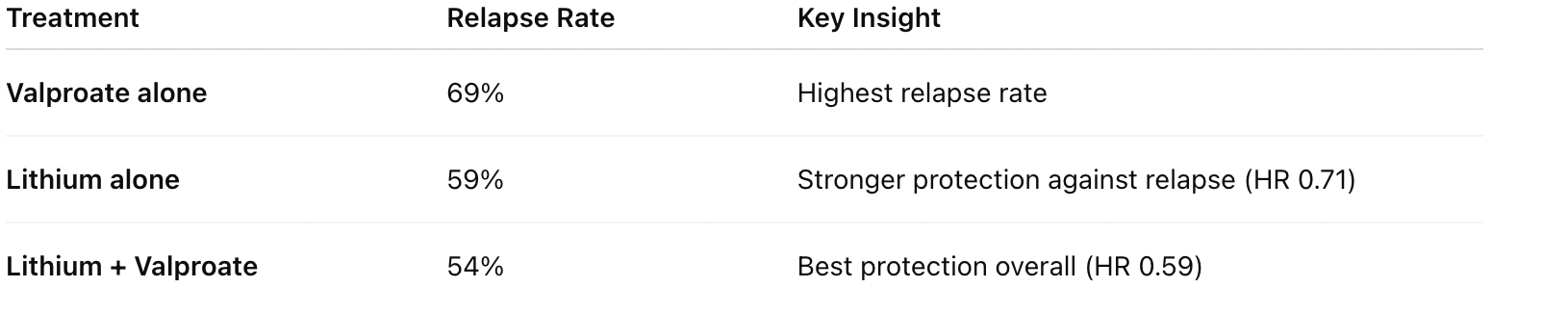
- Valproate alone: 69% relapsed or had a major mood episode
- Lithium alone: 59% relapsed
- Lithium + valproate: 54% relapsed
Compared to valproate:
- Lithium reduced relapse risk significantly (HR 0.71)
- Combination therapy did even better (HR 0.59)
Bottom line: Lithium monotherapy outperformed valproate and came close to combination therapy — showing it's still a frontline option.
Why Should You Care
Because relapse in bipolar I disorder can be devastating, and choosing the right maintenance plan can prevent major mood episodes.
One number to know: Patients on lithium alone were 10% less likely to relapse than those on valproate.
The Article
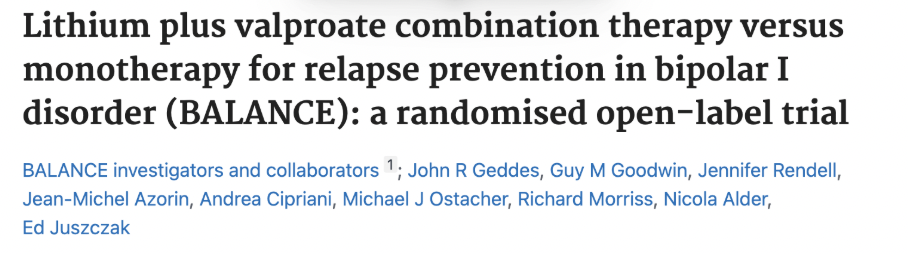 Full article: https://pubmed.ncbi.nlm.nih.gov/20092882/
Published in The Lancet, one of the most respected medical journals globally, the BALANCE Trial used a randomized, controlled, multi-center design. That means its findings are both clinically reliable and directly relevant to everyday treatment decisions.
The Clinical Data
Serious adverse events:
- Valproate: 7 events (3 deaths)
- Lithium: 5 events (2 deaths)
- Combination: 4 events (1 death)
- While risks were low across all groups, lithium remained effective and relatively safe.
Study Design: How They Figured It Out
- Study: BALANCE Trial (Bipolar Affective disorder: Lithium/ANtiConvulsant Evaluation)
- Type: Randomized, controlled, international study
- Participants: 330+ adults with bipolar I disorder
- Duration: 24-month follow-up
- Treatments compared:
- Lithium monotherapy
- Valproate monotherapy
- Combination therapy (lithium + valproate)
- Focus: Preventing relapse and tracking serious side effects
- This was one of the most realistic, long-term trials for bipolar I maintenance care.
Why This Study Changed My Practice
In my early years as a psychiatrist, I often leaned toward combination treatments or newer medications. But the BALANCE Trial taught me to pause.
Now I say to patients:
“Sometimes, the most powerful treatment is the one that’s already proven to work.”
What I changed:
- I no longer underestimate lithium — I now consider it first-line for bipolar I
- I’m more cautious with polypharmacy — more meds often mean more side effects
- I help patients see that simplicity isn’t weakness — it’s clinical wisdom
- I reserve combination therapy for more severe or treatment-resistant cases
What Patients Should Know
- Lithium is still the gold standard for bipolar I maintenance
- If you tolerate lithium well, it may give you the best long-term stability
- Valproate alone may not protect against relapse as strongly
- Combination therapy can help in some cases, but adds complexity
- Always weigh side effects, labs, and lifestyle when choosing a plan
- The best treatment isn’t always the newest — it’s the one that works
Final Thought
The BALANCE Trial reminded us that in bipolar I disorder, stability isn’t about complexity — it’s about choosing wisely. Lithium, though decades old, remains one of the most effective tools we have. It’s not just about controlling symptoms — it’s about protecting long-term wellness.
For many, a well-tolerated lithium regimen offers the right balance of simplicity, power, and durability. In bipolar care, doing more isn’t always better — sometimes, it’s about doing what works and sticking with it.
🔗 Link to the study: https://pubmed.ncbi.nlm.nih.gov/20092882/