STEP-BD Trial: Why Antidepressants Don’t Always Help in Bipolar Depression
Description: Published in the New England Journal of Medicine in 2007, the STEP-BD Trial (Systematic Treatment Enhancement Program for Bipolar Disorder) remains one of the largest and most influential studies on bipolar depression. It asked a critical question: Do antidepressants actually help when added to a mood stabilizer? The answer? Not really. Recovery didn’t improve, and concerns about destabilization grew.
The Takeaway
Antidepressants didn’t improve outcomes when added to a mood stabilizer — and in some ways, they underperformed.
Key numbers:
- Mood stabilizer + antidepressant: 23.5% recovery rate
- Mood stabilizer + placebo: 27.3% recovery rate
- No statistically significant difference (p = 0.40)
- Risk of switching into mania: similar in both groups
Bottom line: Adding an antidepressant didn’t help — and in some cases, may have added risk without reward.
Why Should You Care
Because bipolar depression isn’t the same as regular depression. What works for one can backfire in the other.
One number that matters:
Patients on mood stabilizers alone recovered more often (27.3%) than those on mood stabilizers plus antidepressants (23.5%).
The Article
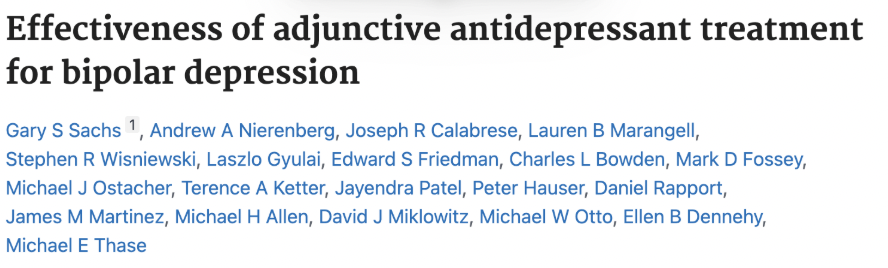 Full article: https://pubmed.ncbi.nlm.nih.gov/17392295/
This trial was published in the New England Journal of Medicine, one of the most trusted medical journals worldwide. The STEP-BD Trial was a multi-site, randomized controlled trial (RCT) — the gold standard for clinical evidence — making its findings especially reliable for doctors and patients alike.
The Clinical Data
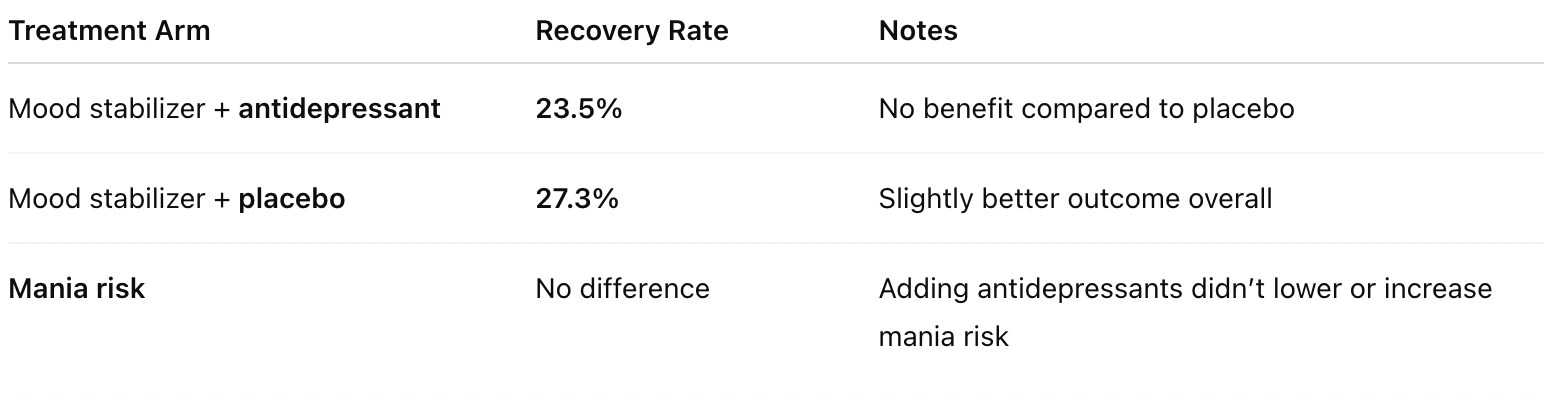
Some secondary outcomes actually favored placebo. That’s right — patients doing less ended up doing better.
Study Design: How They Figured It Out
- Study: STEP-BD
- Design: Randomized, placebo-controlled, multi-site trial
- Participants: 366 adults with bipolar depression
- Treatment arms:
- Mood stabilizer + antidepressant (either bupropion or paroxetine)
- Mood stabilizer + placebo
- Outcomes measured: Recovery rates and risk of switching to mania
- Published: New England Journal of Medicine, 2007
This was a real-world, practical study — designed to reflect how patients are treated in everyday practice.
Why This Study Changed My Practice
Before STEP-BD, I — like many clinicians — had a reflex: depressed? Add an antidepressant.
This study changed that completely.
Now I explain to patients:
“In bipolar depression, more medication doesn’t always mean better outcomes. Stability is the goal.”
After STEP-BD, I began to:
- Prioritize mood stabilizers like lithium, lamotrigine, and valproate
- Avoid antidepressants unless clearly needed and closely monitored
- Educate families about the risks of mood destabilization
- Track symptoms more carefully, focusing on balance over speed
What Patients Should Know
- Bipolar depression is different. It needs its own approach — not just a copy-paste from standard depression care.
- Mood stabilizers are key. They form the foundation of safe, effective treatment.
- Antidepressants aren’t always helpful. In some cases, they may even increase risk of relapse or mania.
- You can ask questions. It's okay to say: “Do I really need this medication?”
- Stability over speed. The safest plan may not be the fastest — but it's the one that lasts.
Final Thought
The STEP-BD Trial reminded us that treating bipolar depression is about more than lifting mood — it’s about protecting long-term balance. When we rush to fix sadness without understanding the full picture, we risk doing harm.
Trust the data. Sometimes, doing less leads to more stable, sustainable healing.
🔗 Link to the study: https://pubmed.ncbi.nlm.nih.gov/17392295/